

Related Articles:
The 10-Part Stress Series
Previously in this Series: What is stress?
Before we can identify what causes stress, we need to get a better handle on what stress is. In the previous article in this series, we learned that stress is the body’s automatic reaction to a change.
That’s all well and good but most of us know at least one person who we think of as “stressed out” or “under stress.” At least on the surface, that person may not appear to be reacting to any kind of change. In fact, they can often seem stuck in a rut. And then perhaps a friend will mention that she’s all “stressed out” over an upcoming flight to Florida because she’s afraid of flying. So what gives?
In the previous article, we met an ancestor of ours who had a run-in with a leopard in Africa two million years ago. The leopard was looking for lunch and our ancestor was looking a lot like a Big Mac. Fortunately, he found a sturdy stick and was able to fend off the leopard. Since then, he has continued on his journey and has now come to a river. The water is flowing quickly and there are vines crossing overhead. He peers into the river but he cannot see the bottom.
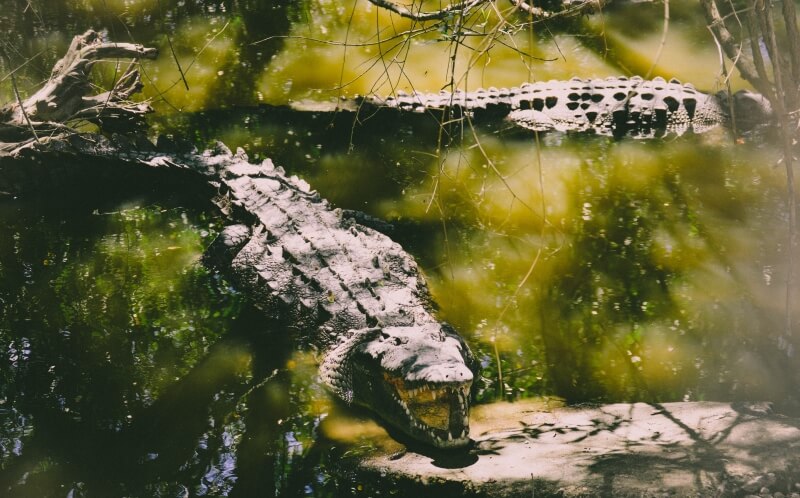
He needs to get to the other side but those vines don’t look too sturdy. He’s a good swimmer but some of these rivers have crocodiles in them. Two million years ago, those crocs were big – and hungry. Having escaped being lunch for a leopard, he’s not keen on being a snack for a crocodile.
He stands there looking into the river, trying to decide what to do. He doesn’t feel good about this at all. He doesn’t see any crocodiles and it’s a nice warm day but still he can’t shake his feeling of apprehension. He is worried about getting across the river safely. This is anxiety: an uneasy feeling that something just isn’t right.
Then he sees a crocodile surface and then another and another. Suddenly, the threat is clear. There is mortal danger facing him in the river. This is fear because the threat is now clear and right in front of him. He’s not in danger so long as he stays out of the river but he must cross to continue his journey. He is now afraid.
He looks at the vines and decides that his best course of action is to cross the river hand over hand on the vines. Perhaps the crocodiles won’t notice him as he passes overhead. Halfway across the river, he looks down. Below him is the biggest crocodile he’s ever seen, looking up at him, following his path over the river. The threat couldn’t be clearer as his body mounts a stress response. With clarity of mind, he flees from the threat. His muscles, now engorged with blood, power him across the rest of river. He collapses on the other side and rests while his brain undoes the stress response.
Worry, Anxiety, Fear and Stress
Worry, anxiety, fear and stress are all related, but they are different:
- Worry is a pattern of negative thoughts about something that might happen. Worry is in our mind.
- Anxiety is a general sense of foreboding or apprehension that something just isn’t right. Anxiety is like a stress response without a clear threat. Anxiety is in our mind and also in our body.
- Fear is an emotional reaction to a known or clear threat. While fear that arises from an imminent threat might well induce a stress response, fear doesn’t always involve stress and stress doesn’t always involve fear.
- Stress is the body’s response to a change that represents a threat.
The neurocircuitry in our brains that controls the fear/anxiety response has considerable overlap with the circuitry governing the stress response. Consequently, when trying to evaluate stress, fear and anxiety, it can be helpful to look for the source of the feeling or reaction:
- Is there a known, specific threat?
- Is it real?
- Has there been some change that has brought about the immediate threat?
Acute Stress vs. Chronic Stress
We now know that stress can accompany worry, anxiety and fear, but it is distinct from each of them. This distinction is important if we are to understand stress itself. But what about the person who always seems “stressed out”?
The examples of stress that we’ve seen so far have been caused by clear changes that created a serious threat. When the threat was removed, the brain reversed the stress response and all was good. This kind of stress is called acute stress but not all stress takes this form.
Chronic stress can occur when there are factors in our lives that leave us feeling pressured and overwhelmed over a period of time. Chronic stress is characterized by a long-term stress response. The stressors continue and so does the stress response. This can have very serious impacts on our health and our happiness.
What Causes Stress?
If we ask what can cause stress, the answer is “almost anything” because we are distinct individuals. We bring our distinct knowledge, judgment and life experience along as we walk through life. Our differences in those areas are what can make something stressful for one person but not at all for another.
Since anything can be a stressor for some people, it’s useful to try to understand what makes something stressful. That understanding can help us recognize stress and deal with it when we are faced with a new form of stress.
Stressors are generally divided into two broad classes:
- Physical Stressors: stressors that originate in the physical world
- Psychological Stressors: stressors that originate in our minds
These are sometimes subdivided into:
- Absolute Stressors: stressors that would stress absolutely everyone
- Relative Stressors: stressors that would stress some people but not others
For example, if two people are camping at a campground in a forest and a forest fire erupts around them, that would be an absolute physical stressor. The fire is a clear, physical threat to life and limb and everyone in the forest would be stressed by it. On the other hand, if the same two people were swimming in the open ocean, one person might be enjoying the experience while the other is stressed by every fish and shadow that passes by.
What Makes a Stressor Stressful?
We know that stressors are evaluated as threats by our brain but what makes them threats? Generally, most stressors will include some or all of these characteristics:
- They’re sudden and unexpected.
- They pose a clear threat to our body, our life, our way of thinking or something that is important to us.
- They are something that we haven’t experienced before. Repeated experience with a stressor will often teach us how to deal with it, which has the effect of reducing the threat if it recurs.
- They threaten our ability to control our life in some way.
Common Stressors
Some of the most common stressors in everyday life include:
- A change in life status (getting married, getting divorced, having a child, a death in the family, losing a friend, becoming a caregiver, losing a job, starting a new job, retiring, loss of independence, becoming homeless)
- A traumatic effect (rape, theft, domestic abuse, witnessing a death, a natural disaster)
- Financial problems (loss of income, new financial obligations, high level of debt, not being able to pay the rent or mortgage, wanting a nicer lifestyle, not understanding how to manage money well)
- A serious injury or accident (automobile accident, broken bone, serious illness, falling at home or elsewhere, receiving a serious diagnosis)
- Problems at work (workload too high, working too many hours, poor management, perceived lack of respect, lack of acknowledgment, office politics, changes in the organization, difficult deadlines)
- Threats to our personal point of view (politics, religion, professional, relationships)
Suggested Reading:
The 10-Part Stress Series
Next in this Series: Types of Stress