


Related Articles:
The 10-Part Stress Series
Previously in this Series: The Effect of Stress on our Brains, Minds and Lives
In What is stress?, we looked at what stress is. In other related articles, we’ve looked at what causes stress and how it affects our bodies and our brains.
We’ve learned that chronic stress directly causes chronic inflammation and that chronic inflammation directly or indirectly causes death and disease.
We’ve also looked at ways to prevent or manage stress.
But stress is a regular part of all our lives. In the modern world, it’s almost impossible to escape stress completely – nor would we want to because some stress is healthy and a life completely free of stress would be boring.
Coping With Stress
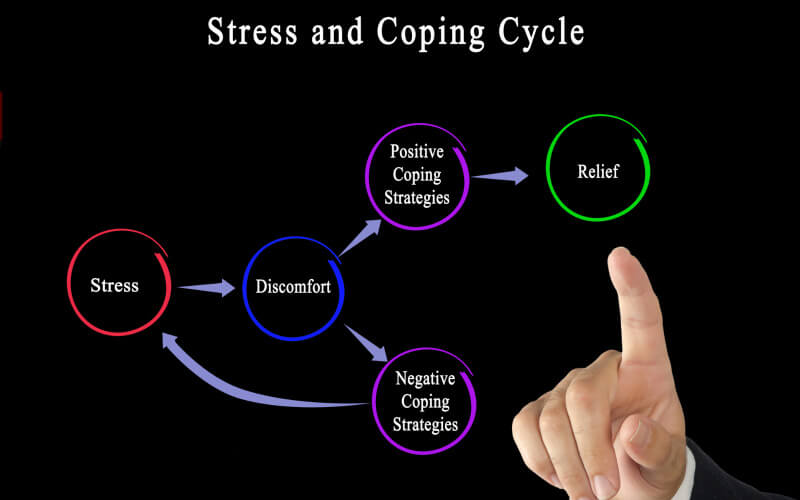
No matter how well we manage our lives, we all need to cope with stress. Many of us will need to cope with stress frequently – sometimes every day and sometimes multiple times per day.
Not coping effectively with the stress we do face can allow stress to ravage our bodies, our minds, our lives and our relationships – not a good choice.
It might seem like the goal of coping strategies would be the elimination of stress. Sometimes, that’s true but, in many instances, the source of stress cannot be easily eliminated. In those cases, the goal is to learn how to live with the stress and eliminate or reduce its negative impacts on our lives.
Coping with stress effectively often requires a bit of detachment and understanding. Granted, if we’re in a building that’s on fire, we don’t need detachment: we need to exit the building as quickly and safely as we can.
But much of the stress that people experience today is less urgent and less life-threatening. Instead, it’s often more ongoing and sometimes feels like it’s never-ending.
This is where effective coping strategies can make a real difference in our lives.
Ready for battle

In order to be able to meet stress head on and cope with it effectively, it’s best if we are as fit physically and emotionally as we can be. If we’re sick, unhappy, lonely, drunk or drugged out, it’s not likely that we’ll be able to cope with stress effectively.
Instead, it’s a good idea to bring our best selves to the table when we’re coping with stress.
That means:
- Eating healthfully and trying to maintain a healthy weight.
- Engaging in physical activities that keep our bodies fit and moving
- Not abusing nicotine, alcohol or drugs.
- Maintaining healthy relationships.
We know that these are the things that help us fight off disease and postpone the effects of getting older. For many of the same reasons, they also help us have the physical and mental strength to control the stress we face.
Where to start?
The first step in coping with stress is to be aware of stress and to be on the lookout for it. Noticing when we’re stressed will give us a chance to cope with the stress.
Not being aware of stress means that we have little chance of dealing with it effectively.
The next step may seem surprising: when we do find stress in our lives, no matter if its large or small, it’s worth looking at it with a bit of detachment. Instead of reacting immediately or emotionally, it is often useful to look at the source of our stress from multiple angles.
Try turning it around or looking at it from the perspective of someone else. Ask yourself if it can be turned into an opportunity? Can we turn it into a personal challenge that might even be fun? Can we use it as a source of personal growth?
When we can turn stress into a positive force in our lives, that’s the best coping mechanism of all. That’s not always possible but, given the possible benefits, it’s worth thinking about.
Lowering your stress level

Someone once said that the first thing to do in an emergency is to light a cigarette. They weren’t talking about the health benefits of cigarettes.
Instead, they meant that very often the best thing to do first in an emergency is stop and think for a minute before taking any action.
The same thing can be true with stress.
Instead of reacting quickly and possibly wildly, stop for minute to think.
Give yourself a bit of time to relax. Try using simple relaxation techniques to lower your stress level. If you’ve got time, try taking a 1-minute vacation.
You may well find out that taking a moment to think before reacting allows you to react in a far better manner than if you had reacted immediately and instinctively.
7 Steps to Success

Once your stress level is no longer at maximum, purposefully take a deep breath and commit yourself to coping with your stress.
Then use the following 7 steps to create a realistic plan to cope with your stress. Take time to write down the answers to the first four questions, the consequences you identify in step 5, and the plan you create in steps 6 and 7.
- Identify the source of your stress. What is causing the stress? Is it something external to you? Is it a reaction to something internal?
- Identify the type of stress. Is acute stress? A recurring episodic stress? An ongoing, chronic stress?
- Decide how important the stress is. Is it something that’s annoying and that you can laugh away much as you might swat away a mosquito or is it life-threatening or somewhere in between?
- Decide how urgent the stress is. Is it something that you have to address right now or can it wait? If it can wait, is it possible that simply letting it wait in the background will let it fade away?
- Identify any consequences associated with dealing with the stress or choosing to ignore it for some period of time. If your arm is bleeding heavily, you will need to act quickly in order to avoid life-threatening complications. On the other hand, if an annoying friend keeps calling you, simply letting the calls go to voicemail may well be the best course of action.
- Create a plan of action. Decide how you will deal with the source of the stress. The plan should include action steps that you will take and a timeline for taking those steps. The plan might be as simple as finally calling a plumber to fix the annoying toilet that keeps running. On the other hand, if the source of your stress is an impossible boss, the plan might be a series of steps that will lead to finding and accepting a job at a different place of work. The only things that are needed are a series of steps that you will take and a timeline that you will follow.
- If a problem seems too big or too complicated to create a plan, break it into smaller chunks and then build a plan for each chunk. If those chunks are too big, break those into smaller chunks, too. Eventually, this process will allow you to create a plan of action for every component of the larger problem.
Three approaches for coping with stress
There are many different strategies for coping with stress.
Some strategies may work better for some people than others. Some strategies may work better with different kinds of stress or with stress that comes from different sources.
For example, what works when coping with stress at work may not be the best strategy when dealing with stress that comes from long-term medical issues.
It’s worth familiarizing yourself with a few main approaches. We’ll briefly describe three such strategies below. Each one is the subject of an entire article and the links to those articles are also provided below.
Problem, Appraisal and Emotion Focus
Not all problems and sources of stress can be neatly thought of as an outside problem. Sometimes, the source of the stress is inside us instead of stemming from an external problem.
In other instances, the problem is external but is not something that we can easily change.
Different approaches to coping with stress can be helpful with different types of stress.
- Problem-focused coping: When our stress stems from an external problem that we can identify and do something about, creating a plan of to fix the problem can be a successful coping strategy. Sometimes we need to learn new skills or reach out to others for help in solving the problem but the desired solution is focused on fixing the problem.
- Emotion-focused coping: If our stress is being caused by our emotional reaction to a stressor, the best coping strategies might revolve around adjusting our emotional response instead of trying to solve the problem. Sometimes, the best way to cope with stress is to go for a walk or work out or call a friend or take a nap – anything to help lower our immediate emotional reaction to the stress. For ongoing kinds of stress, seeking advice or therapy to learn how to change our emotional response to stress can be a very effective way to lower the impact the stress has on our body and our life.
- Appraisal-focused coping: Some stress comes from how we view the stress or think about it or the assumptions we are bringing to the table. While it can sometimes be difficult to honestly challenge our own assumptions, doing so can be quite helpful. When looking at stress from this perspective, we might find that we can think differently about the source of stress and thus lower the stress level. Perhaps we can distance ourselves from the source of stress, intellectually or emotionally. Perhaps we can change our response or find some humor in the situation. Perhaps changing a goal by substituting a satisfying new goal will help reduce the stress.
Avoid, Alter, Accept, Adapt (The 4 A’s)
The 4 A’s offer practical strategies for lowering, eliminating and coping with stress.
In many cases, one of the 4 A’s will provide a decent, practical approach to coping with the stress that we are facing.
- Avoid: Often, stress can be lessened or eliminated simply by avoiding the source of stress. Do red lights drive you crazy when driving? Consider taking a somewhat longer route through side streets that don’t have any lights. Does social media raise your blood pressure? Consider taking a break for a month. If your cousin irritates you, perhaps you can find ways to avoid conversation. Is your free time constantly being used up by people asking you to do things you don’t really want to do? If yes, practice saying “I’m sorry, but no.”
- Alter: Your time, your resources, your emotions and your sanity are all important. If someone isn’t treating any of those fairly or is intruding on parts of your life, set limits and make them clear, preferably in advance. “I can meet for one hour only.” “I’m sorry but I can’t contribute to that organization.” “That sounds fun but I don’t want to go.” In each of those sentences, you are using the work “I” to specify what you can and cannot do, are willing to do, and are able to do. Set limitations and stick to them.
- Accept: If you can’t avoid something that is stressful and you don’t have the power to alter it, is it possible to find a way to accept it? Recognizing that accepting stress is a lot healthier than letting it ruin your health and happiness, consider adjusting your emotional response to it. Will forgiving someone or accepting their limitations help? Will forgiving yourself help? Would talking to someone about the situation help? Sometimes, simply understanding that a lot of our stress is coming from our emotional response to something that is stressful can be a powerful step toward controlling our stress instead of letting it control us.
- Adapt: Many times, stress occurs because we’ve placed it upon ourselves. We set standards that are so high that they are difficult to meet – at work, at home, in social situations, when dealing with illness, or perhaps dealing with financial matters. If there are areas of your life that routinely create stress, consider ways to make your burden easier in those situations. Simply lowering the expectations that you place upon yourself can be key to coping with or even eliminating those kinds of stress.
The Three C’s

Psychologists Suzanne Kobasa and Salvatore Maddi proposed a theory of psychological hardiness.
Just as strong trees can easily resist winds that would knock smaller trees to the ground, Kobasa and Maddi believe that increasing our own hardiness will allow us to better resist stresses that might otherwise knock us down.
Even better, increased hardiness can help us see stress in a different light. Instead of viewing it as a negative, we may be able to reframe in a positive way as a challenge and an opportunity to improve our lives and our situations.
- Commitment: Commitment is what it sounds like: being committed to your life, actively engaged and with purpose in mind. People with commitment have a goal or a dream and they work actively toward that goal or that dream. They don’t give up and they persist through challenges. Their goal, dream or sense of purpose helps to provide the motivation to keep moving forward. People without commitment may feel no real purpose in their lives. They may drift through life with little motivation to engage with the people and the world around them. People with commitment are better situated to successfully deal with stress when it comes into their lives.
- Challenge: No one’s life is without problems but how we face those problems can make a huge difference in our lives. People with commitment see problems as challenges to be faced and opportunities for improvement. This positive, can-do attitude can help us overcome even those problems that initially seemed way too difficult. Instead of giving up in the face of a problem, people with psychological hardiness turn negative stress (the problem) into positive stress (the challenge or opportunity). When reframed in this manner, tackling the problem can become easier and sometimes even enjoyable.
- Control: Psychological hardiness helps us to understand that we control our own lives. We are in charge of our lives and we have the power to take steps to meet our goals. When faced with a source of stress, we focus on what we can control instead of what we cannot. Instead of a sense of hopelessness, we look for what we can do and what can change to improve the situation.
Emergency Stress Busting
Sometimes, stress is so immediate or so high that we need an immediate dose of stress busting.
Here are 10 simple things that might help reduce stress in the immediate moment.
- Relax your entire body. Focus on actively relaxing your shoulders, arms, neck and hands. If possible, sit down and relax your legs and feet. Focus for 3 minutes on just relaxing your body.
- Force yourself to smile. Hold the smile and think the happiest thoughts you can muster at the moment. Remember a situation when you were joyful.
- Call a good, reliable friend for a brief “I want to yell but I can’t!” chat.
- Take a deep breath. Hold it for a moment before releasing it. Repeat as needed.
- Laugh. Think of the corniest jokes you know. Think of anything funny but laugh. If near a screen, watch a laugh track on YouTube.
- Remove yourself from the physical situation. Go for a brief walk. Go to the restroom. Get some water. Anything to briefly remove yourself from the stressful situation.
- Go outdoors and sit in the sunlight. Close your eyes and empty your mind for at least three minutes.
- Make a list. Write down exactly what’s stressing you right now. Putting a name on stress can help to render it less potent. Write at least five different things that might be crazy but might be able to help reduce your stress. The items don’t have to be realistic. Jedi warriors with lightsabers might be a real help in some situations!
- Look at some favorite photos on your phone for five minutes. Pets, parents, kids, favorite vacation spots –any favorites will do. Smile while you are looking at each photo and remember why each is one of your favorites.
- Find a dog or cat or stuffed animal and pet it for a few minutes. You’ll feel better and so will they.
The Bottom Line
Chronic stress causes chronic inflammation. Both are associated with many of the leading causes of death and other diseases. Chronic stress and chronic inflammation also change and damage our brains and our nervous systems.
The damage to our brains caused by stress and inflammation has wide-ranging effects on our minds, our emotions and our behaviors. Our ability to learn, think and remember can all be diminished by this brain damage.
Since stress is impossible to avoid, it’s critical to develop attitudes and approaches to successfully cope with stress. These coping mechanisms begin with a stronger understanding of stress, what causes it, and the options we have for addressing it.
Suggested Reading:
The 10-Part Stress Series
Next in this Series: Preventing and Managing Stress