

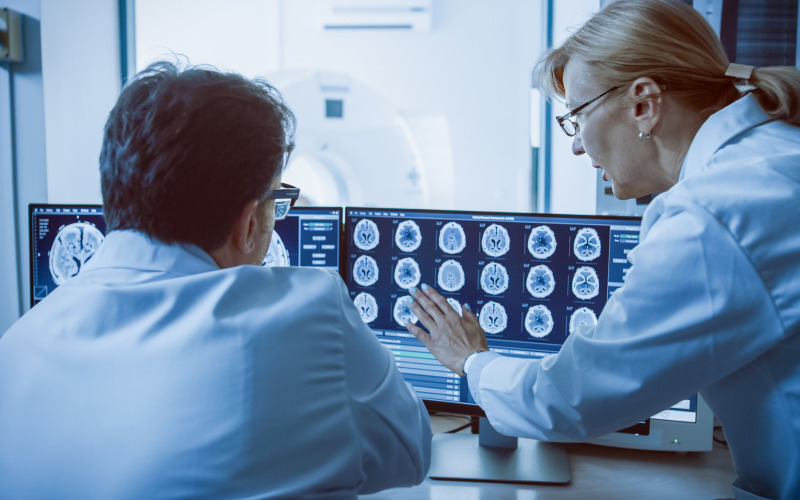
Should mental illness be called “brain disease” instead? And, if so, why?
In this article, we’ll look at this question from several different points of view:
- What are the advantages of calling mental illness a “brain disease”?
- Would it be accurate to call it brain disease? Are mental illnesses simply physical diseases that strike the brain?
- Are there reasons not to call mental illness a brain disease?
- What do the experts have to say about this?
First, let’s define some terms

Without definitions, there can be no shared understanding of terms.
Without a shared understanding of terms, there can be no real communication.
- Disease: When we say that someone is ill, we speak in general terms. Being “ill” is basically the opposite of being healthy. Disease, on the other hand, is very specific. A disease is something that a health care practitioner can diagnose. Diseases have symptoms that are often very specific. Clinical tests and imaging can usually help with the diagnosis of a disease. Diseases have a diagnosis, a prognosis and, usually, a treatment plan.
- Disorder: Disorder refers to a disturbance in functions. Disorders can refer to disturbance in physical functions, mental functions or both. A person can have multiple disorders at one time. Unlike diseases, most disorders are not characterized by physical symptoms that can be identified by clinical tests or imaging.
- Mental Health: The CDC defines mental health as the sum of our emotional, psychological, and social well-being. It affects how we think, feel, and act. It also helps determine how we handle stress, relate to others, and make healthy choices. Mental health is important at every stage of life, from childhood and adolescence through adulthood.
- Mental Illness: Mental illness is caused by one or more health conditions that affect our mental health. Mental illness can affect our thinking, our emotions, our behavior, our well-being, or any combination of those.
- Mental Health Disorder: The World Health Organization states that a mental disorder is characterized by a clinically significant disturbance in an individual’s thinking, emotions or behavior. It is usually associated with distress or impairment in important areas of functioning. There are many different types of mental disorders. Mental disorders may also be referred to as mental health conditions.
- Brain Disease: In its simplest form, a brain disease is any infection, degenerative or functional disease that causes permanent or temporary damage to the brain. There are hundreds of brain diseases. Common categories and causes of brain disease include infections, trauma, tumors, degenerative diseases, cerebrovascular events (like stroke), autoimmune diseases, epilepsy and mental disorders.

Various terms describing mental illness all refer to the same thing.
What’s the difference between a Mental Illness and a Mental Health Disorder?
Not much. Mental Illness is used more often these days, especially by practitioners who believe that most mental health problems stem from diseases of the body (including the brain). Some people try to draw a strong line between Mental Illness and Mental Health Disorder but the line is gray, at best.
How about Mental Health Disease?
If you Google “Mental Health Disease”, you’ll find lots of results – for mental health illnesses, mental health disorders, mental health conditions, mental illnesses – but few or none for “Mental Health Disease”.
Why? Because our understanding of the nature and cause of what we have learned to call mental health “disorders” or “conditions” do not fit the usual definition of a clinically-diagnosable disease.

We understand heart disease as a disease of the heart. Should we think of mental illness as a disease of the brain?
What are the advantages of calling Mental illness a “Brain Disease”?
Think about our reaction to someone having a heart attack. Our immediate inclination is to call for emergency support, offer them an aspirin and begin CPR if they become unconscious. We recognize heart attacks as dire emergencies caused by damage to a person’s heart.
No reasonable person would suggest that a person suffering from a heart attack just “feel better” and “get back to work”. But our reactions to mental illness are often the opposite.
If someone is suffering from depression, we can often confuse that with simply being sad and try to cheer them up. If they are struggling to get through their daily lives, we encourage them to simply “get over it” and “get back to work”. Our impression of mental illness has largely been characterized by seeing it as some sort of weakness, rather than something akin to a heart attack.
Yet, today, we know that many mental health disorders are tied to and likely caused by changes or damage to a person’s brain. Damage to a heart is seen as a medical emergency. Damage to a brain that results in a mental illness is seen as something to solve with improvements in character.
When someone is suffering from heart disease, we do not call it “smoking disease”, even if decades of smoking are what caused the heart attack. It’s heart disease, regardless of the cause. That’s often not true with mental illness, where a person may be characterized as weak or lazy or criminal or in other negative ways because they developed mental illness.
If we can accurately think of mental illness as “brain disease”, that may well lead to less stigma for those who are suffering from mental illness, more funding for its treatment, a better understanding of the root causes of mental illness, and the development of new treatments.

Research suggests that mental health disorders are clearly tied to changes in the structure of the brain.
Is it accurate to call mental illness a brain disease?
That’s the most important question and there is no clear, universally-accepted answer.
Not all brain diseases cause mental illness. Stroke, epilepsy and Parkinson’s disease are all brain diseases but they do not necessarily cause of involve mental illness. But what about psychoses and depression? Schizophrenia? PTSD? Anxiety? Bipolar disorder?
Can these mental health disorders accurate be considered brain diseases? More and more, the answer seems to be yes, at least in a narrow way. Research has shown that many mental health disorders are tied to damage or structural change in parts of the brain. This is not surprising: to the best of our knowledge, our thinking, emotions and behavior stem from our brain. It would not be surprising if structural changes in the brain can cause changes in the way we think, perceive emotion or behave.
Further, mental health disorders can often be treated by treatments that cause structural changes in the brain. Antidepressants increase the activity of neurotransmitters like seratonin and dopamine in the brain. This can cause structural changes in the limbic system, which is the part of the brain involved in emotional responses like fear. Surprisingly, successful therapy can also cause structural changes in the brain but will more likely cause changes in the part of the cerebral cortex that governs how we feel about emotions.
Antidepressants can get at the source of the emotions while therapy can get at how we think about emotions. Both are attacking the same problem and both, if successful, will cause structural changes in the brain that lead to better emotional wellbeing.
If changes in the structure of a person’s brain can cause mental illness and further changes in the structure of the person’s brain can relieve that mental illness, this would seem to support the premise that mental illness is, at the bottom line, a brain disease.
Are there reasons not to call mental illness a brain disease?
Calling mental illness a brain disease might be problematic, for a variety of reasons. For example, diseases are generally specific. They are able to be diagnosed on the basis of testing and/or imaging and medical practitioners can develop treatment plans for them. Mental health disorders share almost none of those things and are generally large general categories that are categorized by outward symptoms.
By any normal definition of the word “disease”, most mental health disorders will not meet the definition. But is that due to a substantive difference between our understanding of mental health disorders and disease or is there a significant difference between them and “real” brain disease?
There are parallels in medical history. Cancer offers one. At point in time, cancer was viewed as a single disease. Today, it’s a catchall term for a very diverse group of diseases with many different disease pathways. The difference between how we see cancer today and how we saw it 50 years ago is simply the result of research that developed better understanding of cancer. Is our current use of big catchall terms for mental health disorders due simply to our incomplete understanding of the causes underlying those disorders?

Experts do not currently agree on whether mental illness should properly be categorized as brain disease.
What do the experts have to say about this?
There are many different medical specialties that deal with mental illness. Psychiatrists, psychologists, therapists, neurologists, neurosurgeons, and neuropsychologists all have a part to play. As one might expect, there is significant difference of opinion among these groups with regard to whether or not it’s accurate to call mental illness “brain disease”.
Eric Kandel, MD, is a Nobel Prize winner who has been teaching Columbia University since 1974. He specializes in psychiatry, biochemistry and biophysics.
“All mental processes are brain processes, and therefore all disorders of mental functioning are biological diseases,” he says. “The brain is the organ of the mind. Where else could [mental illness] be if not in the brain?”
Thomas R. Insel, MD, is an American neuroscientist who led the National Institute of Mental Health from 2002 until 2015. He also champions a biological perspective of mental illness. Insel sees mental illnesses as no different from any chronic illness, whether its heart disease or diabetes.
He said “The only difference here is that the organ of interest is the brain instead of the heart or pancreas. But the same basic principles apply.”
However, there are many who do not agree.
In 2016, the British Psychological Society’s Division of Clinical Psychology published a report that claimed: “There is no firm evidence that mental distress is primarily caused by biochemical imbalances, genes, or something going wrong in the brain …” The authors suggest that mental illness is due to external, environmental factors like poverty or abuse. Given that, they suggest that treatment should also come from outside the body such as therapy, social change, and the provision of more resources to those who are suffering from mental illness or striving to treat it.
Certainly, the authors of the report are experts in their field and bring great experience to their point of view. However, one might be forgiven if one viewed a statement that medicine cannot replace therapy as potentially biased coming from a group of professionals whose livelihood in some ways depends upon the continuation of existing treatments like therapy.
The historical arc of the development of medicine would seem to suggest that the future lies with more and more development of evidence that mental illness, is indeed, a brain disease and also the development of medical treatments for it.
The Bottom Line
Mental illness has traditionally been seen as different than a “brain disease” and properly treated, at least in part, by therapy that is aimed at “better thinking”. Research over the last 40 years is providing more and more evidence, however, that mental illness is tied to structural damage or changes to various parts of the brain. Seen in that light, mental illness might properly be categorized as a “brain disease”.
Many brain diseases do not involve mental illness. While there is no general agreement at this time among medical practitioners that mental illness is, in fact, a brain disease, there is a growing school of thought that clearly makes that claim.
The hope is that categorizing mental health as a brain disease will reduce stigma for sufferers of mental health while improving understanding of mental illness and providing increase resources for new research and new treatments