

Why Should You Have a Budget?
Related articles:
How to Create a Budget.
How to Use a Budget
Why You Need a Balance Sheet
What to Do and Who to Trust in a Financial Emergency
The Dangers of Financial Stress
Research shows that the majority of Americans do not have a budget. Are you one of them?
There are many reasons why you should have a budget. Here are few of the important ones.
- Having a budget can improve your mental health by helping to reduce financial stress.
- A budget can make you happier.
- A budget gives you more control over your life.
- A budget can help you gain financial independence and freedom.
- A budget can make it far more likely that you’ll be able to reach your long-term goals and dreams.

Chronic, ongoing stress connected to money and personal finances affects many people. This kind of stress is unhealthy and can signifcantly impact our lives and our happiness.
Use of a budget can reduce or eliminate financial stress.
Having A Budget Can Improve Your Mental Health
The American Psychological Association’s March, 2022, Stress in America survey found that 72 percent of Americans reported feeling stressed about money at least some time in the prior month.
A 2021 report published by FINRA found that “A substantial number of adults in the United States between the ages of 21 and 62 felt anxiety and stress about their personal finances.” They further noted “Researchers found that financial stress and anxiety are highly linked to low levels of financial literacy, problematic financial behaviors and decreased financial security.”
Financial stress is stress that is related to money: expenses, debt, problems managing money, financial arguments with a partner, emergency expenses – all of these can be part of it.
Here are a few symptoms of financial stress:
- Avoiding bills and creditors
- Not answering the phone because it might be a creditor or bill collector
- Canceling plans with friends because you don’t have the money to go out
- Arguing over money with your spouse, partner, parent or child
- Feeling like you’re just unable to keep up with or control your finances
Financial stress is usually chronic. Chronic stress is stress that is ongoing and never really goes away. In our stress series, we show how chronic stress causes chronic inflammation and how that is tied directly or indirectly to about half of all human disease and deaths.
Properly using a budget can help reduce or even eliminate financial stress. It can even make managing your money interesting and fun. These can contribute a positive improvement to anyone’s mental health.
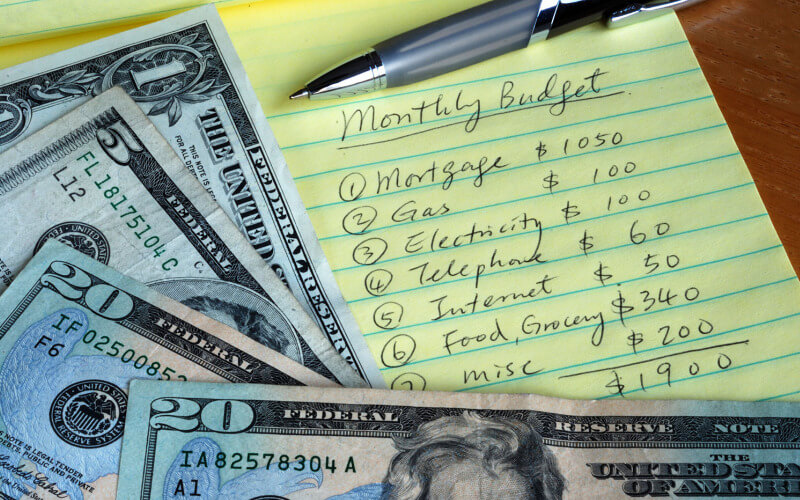
Most people simply aren’t prepared for financial emergencies, much less future goals or retirement.
Use of a budget can help you avoid or address these problems.
A Budget Can Make You Happier
Recent research shows that:
- Only 42% of Americans are comfortable with the money they have set aside for an emergency.
- 56% of Americans cannot cover an emergency expense of $1,000.
- Only half of all Americans have more savings than credit card debt.
- 40% of Americans have less than $300 in savings.
- 32% of Americans did not save anything for retirement in 2020.
These are the kinds of things that cause chronic financial stress and the worry and anxiety that accompanies it. A life characterized by stress, worry and anxiety is, by definition, not a happy life.
A budget can help you address financial problems and help you create a realistic financial plan. It can also identify times where outside help is needed to solve tough financial problems. All of these things can help reduce financial stress and lead to a happier life and a happier family.
A budget is a key tool to enhance your future financial security – and your life.
While creating a budget might seem like a tedious, difficult, unpleasant task, it doesn’t have to be any of those. Instead of viewing a budget as a chore, view it as a key to your future financial security.
A budget can help identify and solve problems immediately but a budget is best seen as a tool to help build a better life in the years to come. Establishing a budget now can have a huge impact on your financial security one year from now, 5 years from now and all the way to and through your retirement.
By helping to enhance your financial security, a budget can enhance your life. Not bad for a simple tool that’s easy to create and easy to manage!

Many people have no idea how much money they’re spending or where their money goes.
A budget provides the tools we need to take charge of our financial lives.
A Budget Gives You More Control Over Your Life
55% of Americans don’t use a budget and only 30% have any kind of written financial plan. When asked why they don’t use a budget, many say that they don’t think it’s important. However:
- 56% of Americans say they don’t know how much money they spent last month.
- A third of Americans wish they has spent less money in the last month.
- Only 24% of Millennials demonstrate basic financial literacy.
It’s hard to control our lives if our finances are out of control and the next emergency might easily result in severe financial hardship. Gaining control of our finances gives us much more control over our lives and our futures.
A budget can help us:
- Understand what money is coming in and where it’s going
- Identify waste
- Provide choices instead of being at the mercy of the financial winds
- Identify problem areas
- Help set realistic short-term and long-term goals
- Help create an emergency savings plan
- Facilitate conversations with spouses, children, parents, partners and roommates
A Budget Can Help You Gain Financial Independence and Freedom
If your goal is to be financially independent and free of financial worry, a budget can help. Aligning your budget with your goals and financial plan will keep you in control. With a budget, you can be comfortable that you are using your money in ways that will best help you reach your goals.
Not only that, by identifying and eliminating waste, a budget can help you meet your financial goals faster. A budget will also allow you to track your progress toward your financial goals.
Peter’s partner wants to spend a week in Italy next year. The average cost of a week-long trip to Italy for two people is $2,000. He doesn’t know how he’ll cover that, so he looks at his budget.
He sees that he’s spending a lot of money on “outside food”. When he looks into that, he sees that he’s spending $5.25 every day on a vanilla latte at Starbucks. If he can cut that out and bring a coffee from home, he’ll save the money he’s currently paying Starbucks every day.
He will have to pay for the cup of coffee he will make at home but he calculates that will only cost him $0.25 per cup. That means he’ll be saving $5.00 every day ($5.25 minus $0.25). That’s $150.00 per month. Over 12 months, he’ll have saved $1,800.00.
To bring his partner on a weeklong vacation in Italy, all he has to do is find another $200.00 and then he and his partner are winging their way to sunny Italy – all because his budget helped him to understand that he could cut out a recurring minor expense and trade it for an important long-term goal.
There’s an old saying “you get what you measure”.
If you’re not measuring anything, then you’re a leaf in the wind. On the other hand, if you are tracking your progress toward your financial goals with a budget, you can make financial decisions with confidence that you are moving in the right direction to reach your goals.

Most people have dreams and most dreams cost money.
Using a budget can greatly increase the chances that you’ll be able to realize your dreams.
A Budget Can Make It Far More Likely That You’ll Reach Your Long-Term Goals and Dreams
Speaking of goals, they come in all sizes. On a warm sunny afternoon, an appropriate goal might be to leave work early enough to get an ice cream cone. But a long-term realistic goal for someone in their 20s might be to have enough money to retire comfortably at the age of 60.
Some goals are in the middle. Perhaps you need a new car or a new washing machine. Perhaps your partner really does want to take that week-long vacation to Italy next summer. By identifying the cost of these things and plugging them into your financial plan and budget, you can fairly quickly:
- Identify if the planned expense is reasonable in the time frame you hope to make it
- Identify what needs to be done to make the expense fit into your budget.
Large-ticket expenses don’t need to be the source of great stress and arguments. Instead, they can become part of a realistic financial plan. And if the budget doesn’t support them, perhaps it’s time to look at the income side of the budget instead of just the expense side.
Perhaps it’s time to add a part-time job. Perhaps it’s time for your partner to think about going back into the workforce. Perhaps there are ways to consolidate debt and lower the monthly impact on your budget. If you are debt-free, perhaps there are low-cost ways to borrow the money needed for the big-ticket expense, with the comfortable knowledge that your budget will cover the repayment terms.
Dreams and plans should be a part of everyone’s life. Having a financial plan and a budget can be a key to making those dreams come true.
Negatives of not having a budget
Suppose that you don’t want to bother with a budget. What are some of the negatives associated with that decision?
- People without a budget tend to have far more credit card debt than do people with a budget.
- Having far more credit card debt means paying a lot more interest to your credit card issuer each year.
- Not having a budget can result in late payments or missed payments. These can create problems with your credit rating, which can make life more difficult in a variety of ways.
- Not having a budget likely means not having a financial plan. That can make you exposed to emergency expenses and far less likely to reach whatever financial goals you do have.
The Bottom Line
Budgets get a bad rap and most Americans don’t use them – even though budgets and financial plans are easy to create, easy to use and help provide needed structure to our financial affairs.
Going through life without a budget and hoping to get to old age with enough money to survive would be like driving out of New York City and heading in any old direction with the hope that you’ll end up in Los Angeles. Every day, you just get in the car and head off in some direction, never knowing where you’re going or if there will even be food or lodging where you end up.
At the end of your journey, you might be in Georgia or Idaho or Maine, which are perfectly fine places but if you really wanted to get to LA, then you’ve ended up someplace that isn’t where you wanted to be. If only you had opened a map when you started, you could have driven directly to LA, saving a lot of money on gasoline, and likely arrived early so you could enjoy your destination for many extra years.
If you’re ready to start creating a budget, see How to Create a Budget.